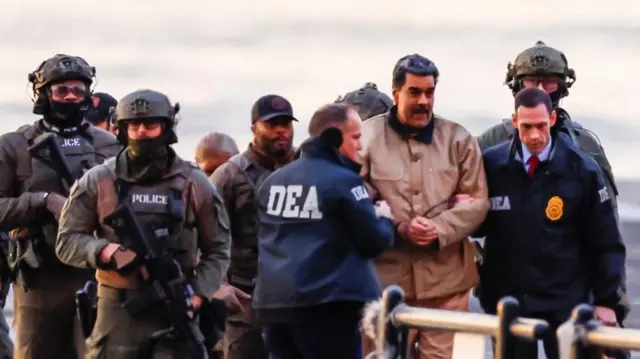
In January 2026, the international political system experienced its most structurally destructive upheaval since the end of the Cold War. The Trump administration launched Operation Absolute Resolve, a special military operation that raided Caracas, the capital of Venezuela, forcibly capturing President Nicolás Maduro and extraditing him to the United States for trial on charges of "drug terrorism." This series of "law enforcement" actions disguised as "decapitation strikes" not only showcased the extreme power of the United States but also signaled a crisis of complete collapse for the post-World War II international legal system.
"I don't need international law" and the extraterritorial expansion of unilateral jurisdiction
To understand the underlying logic of this action, it is necessary to examine the paradigm shift in US foreign policy. For decades, US military interventions have often been cloaked in the legal guise of "humanitarian intervention" or "collective self-defense." However, this action is directly defined as "transnational law enforcement," with President Trump even publicly declaring, "I don't need international law," and its power constrained only by "personal morality."
This has devastating legal and geopolitical implications. Professor Allen S. Weiner of the Stanford Center for International Conflict and Negotiation points out that while the traditional Westphalian system grants heads of state absolute sovereign immunity, this move by the United States effectively establishes a new principle of unilateral jurisdiction: US domestic law has extraterritorial effect that transcends national borders and supersedes the sovereign status of the target country. The FBI has even reactivated the 1989 Cold War-era legal opinion, the Barr Memo, arguing that arresting suspects internationally should not be considered in light of violations of international law. This means that any foreign leader prosecuted in a US domestic court could theoretically become a legitimate target of the US military, and regime change could be easily disguised as a routine "arrest operation."
Faced with a superpower possessing overwhelming military superiority and openly disregarding rules, the international community is mired in an unprecedented legal dilemma. Legal experts from the Atlantic Council and Chatham House point out that while the UN Charter explicitly prohibits the use of force against sovereign states, the UN Security Council is completely paralyzed by the US veto power, unable to pass any resolutions of condemnation. Even traditional allies like Britain and France are caught in a dilemma, only able to vaguely appeal to the "rule of law," a strategic silence that effectively constitutes tacit approval of the disruption of international order.
The radical practices of the "Donglio Doctrine" and the cracks in the alliance system
The Trump administration's actions are not an isolated incident, but a direct practice of its "Donroe Doctrine"—a radical variant of the Monroe Doctrine—proposed in 2025. If the Monroe Doctrine of 1823 aimed to prevent European powers from interfering in American affairs, the "Donroe Doctrine" asserts that the United States possesses the "natural right" to directly intervene in, manage, and even change regimes in the Western Hemisphere, and views the natural resources of other countries as key assets for U.S. national security.
This extreme deterrent, a "killing the chicken to scare the monkey," is not only directed at hostile countries but has also shockingly affected America's allies. Colombia, a left-wing government in Latin America, immediately faced a blatant military threat of "invasion" from Trump after criticizing US intervention, forcing its president, Gustavo Petro, to quickly soften his stance and seek compromise.
What further exposes the imperial nature of "Donglioism" is the action against Denmark and Greenland. After "taking down" Maduro, Trump reiterated the purchase of Greenland and threatened to use military force. The Danish Prime Minister warned that this would mean "the end of NATO," touching upon the core paradox of collective defense treaties: what is the point of Article 5 when the threat comes from the leader within the alliance? Even Canada was anxious about Trump's "51st state" rhetoric and was forced to take a tougher stance on sovereignty claims. This shows that the US alliance system is shifting from being based on shared values to being based on fear-based obedience, which will seriously weaken the cohesion of the West in the long run.
Systematic dismantling of the global governance architecture
Simultaneous with this "hard kill" was the United States' "soft purge" of the global governance system. The Trump administration announced its withdrawal from 66 international organizations and treaties, including the United Nations Framework Convention on Climate Change (UNFCCC) and the Intergovernmental Panel on Climate Change (IPCC). This was not merely an abandonment of global climate leadership, but an attempt to paralyze global climate action by cutting off funding and to renationalize technological development.
The US withdrawal of funding has dealt a devastating blow to the UN budget, potentially leading to cuts in humanitarian aid and peacekeeping operations, and further diminishing the UN's influence in hotspots. The world is regressing from a rules-based order to a power-based order, and the UN risks becoming merely a forum for venting grievances.
However, the US withdrawal has also provided opportunities for other forces to fill the vacuum. The EU and China are strengthening bilateral cooperation in climate and scientific research, while the BRICS New Development Bank (NDB) is expanding green finance and promoting local currency lending to reduce dependence on the dollar. This has effectively accelerated the division of the world into a "US system" and a "non-US system."


