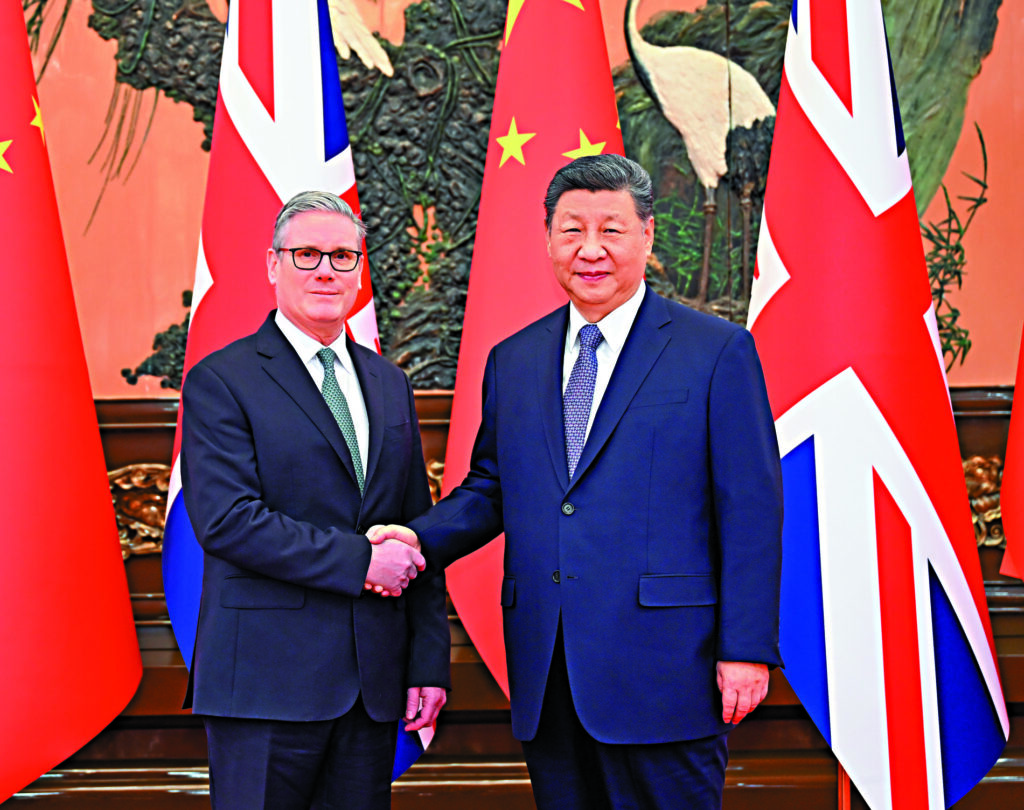
In January 2026, the British Prime Minister will pay an official visit to Beijing and Shanghai, China. This marks the first visit to China by a British head of government in nearly eight years, bringing an end to the fluctuating UK-China diplomatic relations of the past decade. Faced with a profound restructuring of the global order, 10 Downing Street is abandoning its past policy of fluctuating between the "Golden Age" and the "Ice Age," and instead adopting a highly consistent pragmatic realism.
The trajectory from the "golden age" to a "pragmatic restart"
To understand the underlying logic of this diplomatic move, it is essential to review the evolution of UK-China relations over the past decade. The "golden era" of 2015 centered on infrastructure investment and financial integration; the UK even joined the Asian Infrastructure Investment Bank (AIIB) despite Washington's opposition. However, this optimism was subsequently hit by a series of systemic shocks. As political differences widened on issues such as Hong Kong and Xinjiang, and concerns about technological espionage arose, relations quickly entered a "glacial period." During this time, the UK government decided in 2020 to remove Huawei from its 5G network and passed the National Security and Investments Act 2021.
This 2026 visit formally established the third phase of bilateral relations: a "pragmatic restart." The current leaders no longer harbor illusions of political convergence, but rather soberly acknowledge the reality of China as an "influential power." The British government recognizes that long-standing policy inconsistencies have harmed British national interests, leaving businesses bewildered and weakening London's influence over Beijing on global issues such as climate change and international security.
The rift in the transatlantic alliance and Britain's strategic autonomy
A key variable driving Britain's strategic shift lies in the US factor. Britain is attempting to mend its relationship with China at a time of extreme volatility in transatlantic relations. The strong return of the Trump administration in 2025 brings significant uncertainty, forcing London to rethink its absolute dependence on Washington.
The recent "Greenland Crisis," in particular, with the US president threatening tariffs on NATO allies if no agreement is reached, has become a significant point of friction. When the US threatened to impose 100% tariffs (effectively an embargo) on Canada due to its economic agreement with China, the UK deeply felt the chill of geopolitics. In response, British Prime Minister Keir Starmer stated clearly in an interview with Bloomberg that the UK would not be forced into a black-and-white choice between the US and China. While the US remains its closest intelligence and nuclear defense ally, ignoring the world's second-largest economy would be a "shocking dereliction of duty."
In the "National Security Fence" and 37Seeking a balance among tens of thousands of jobs
This pragmatic shift is known as the "Starmer Paradox": on the one hand, China is characterized as a "national security threat," while on the other hand, deeper economic ties are actively sought in the financial, life sciences, and green technology sectors. To strike a balance between the two, the British government is committed to building "guardrails" to protect national sovereignty from the "invisible leverage" of economic interdependence. On the eve of its visit to China, the British government approved the construction of a "super embassy" for China in London. Although the project had raised concerns about espionage due to its proximity to critical fiber optic networks in the financial district, the government ultimately approved it, viewing it as an opportunity to concentrate surveillance resources, which undoubtedly released important diplomatic goodwill for bilateral trade negotiations. Meanwhile, the Royal Institute of International Affairs analysis indicates that MI5 remains highly vigilant regarding IoT modules, reliance on green supply chains, and cyber espionage, and the government is also considering adding China to the enhanced level of the Foreign Influence Registry (FIRS) scheme.
On a values-based level, Britain has made it clear that it will not "turn a blind eye" to the democratic setbacks or human rights issues in Hong Kong. The Guardian reported that the Prime Minister pledged a "frank and open" dialogue with Chinese leaders regarding the case of Jimmy Lai, the imprisoned British citizen. At the same time, both sides also demonstrated a willingness to cooperate in areas aligned with their national interests, such as sharing intelligence between their law enforcement agencies to combat the supply chain of Chinese-made ship engines used for human smuggling in the English Channel.
Ultimately, the core driving force behind this visit lies in its "growth mission." Currently, bilateral trade between China and the UK reaches approximately £100 billion annually, making China the UK's third-largest trading partner. More importantly, trade with China supports approximately 370,000 British jobs. Given its constrained domestic finances, the UK has no choice but to adopt a soberly realistic approach, seeking a path to national prosperity amidst challenging systemic competition.


